Solitaire, Classic Card Game
- 0.0
- Rating
- 10.00K
- Installs
- Free
- Price
 Analysis by App-foxy
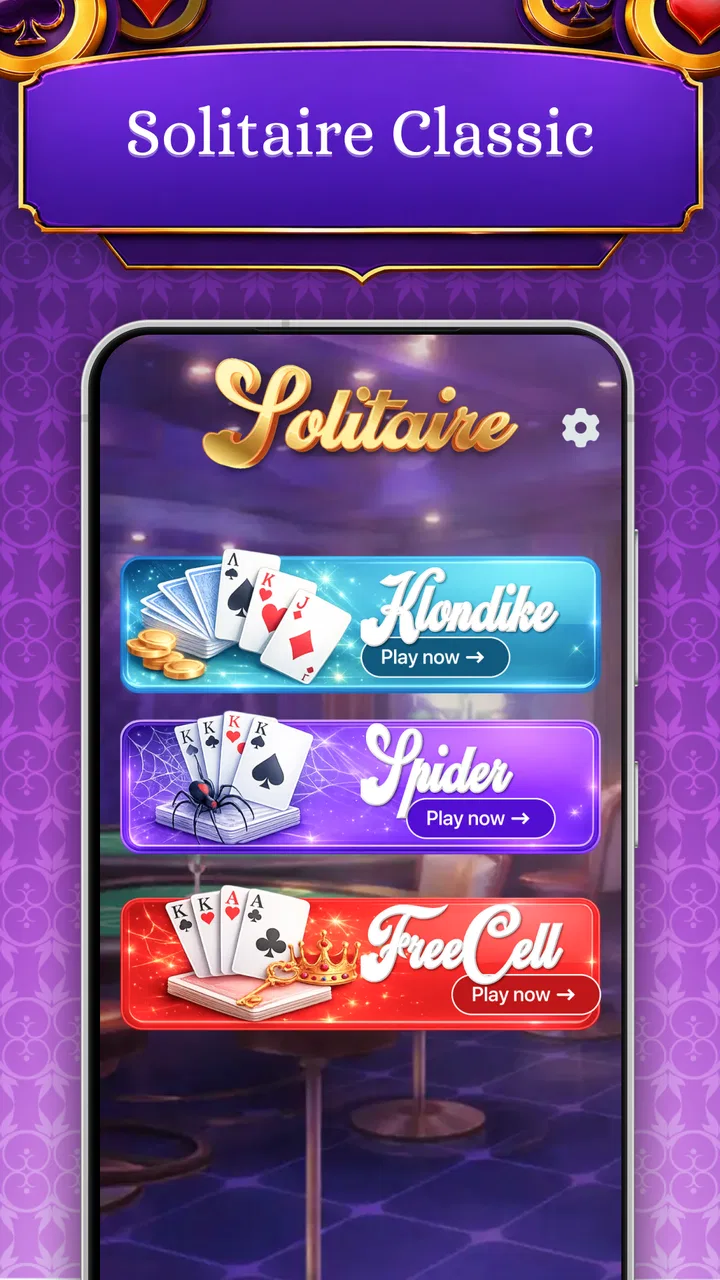
I opened Solitaire expecting a familiar card game rather than a complicated new system, and that is exactly where its appeal begins. This is a free card game from Big Boss Taxi Co., Limited, built around the classic patience-style experience many people already know: arrange cards, uncover hidden possibilities, and keep making small decisions until the layout is solved or the run reaches a dead end. Its store summary also points to Spider and FreeCell challenges, so the package is aimed at players who want more than one traditional format in the same place.
What makes this kind of game worth reviewing is not a dramatic story or a large collection of mechanics. It is the rhythm of a short decision: tap or move a card, see the layout change, gain a little progress, then decide whether the new position deserves another move. I found that this simple loop works best when I want something quiet and immediately understandable. It is easy to begin without learning a long tutorial, yet the familiar rules still leave room for careful planning.
How the first move sets up the whole session
The first action in a Solitaire game is usually modest, but it tells me what sort of session I am going to have. I scan the visible cards, look for moves that reveal covered cards, and avoid spending a useful option too early when another route may open more of the tableau. That opening scan matters more than speed. A rushed first move can remove flexibility, while a patient one often exposes a better sequence.
You May Also Like

 AccuWeather: Weather Radar
AccuWeather Review: A Quick, Clear Forecast for Everyday Decisions
For everyday plans, the best forecast is the one you can understand quickly. AccuWeather makes rain timing, radar, and local conditions easy to act on, with a few trade-offs.

 Hill Climb Racing
Why Hill Climb Racing Still Turns Crashes Into One More Run
A tiny car, a bumpy hill and one more upgrade: Hill Climb Racing keeps resurfacing because its simple chaos makes every near-miss feel personal.

 AliExpress - Shopping App
AliExpress Makes Global Shopping Feel Personal, but Shoppers Bear the Risk
AliExpress turns a global marketplace into a pocket-sized discovery engine. Its reach is useful, its shopping loop compelling, and its trade-offs easy to miss.

 Lords Mobile: Kingdom Wars
Lords Mobile Is a Kingdom-Building Routine, Not a Quick Match
A case-by-case verdict on the building, battles, device demands, and social commitments that make Lords Mobile rewarding for some players and exhausting for others.

 PDF Scanner app - TapScanner
TapScanner Makes Paperwork Easier to Capture, Check, and Share
TapScanner makes scanning with a phone feel less like a rescue operation and more like a dependable step in getting work done. Its capture tools are useful, though not flawless.

 Block Blast!
 Shows How Much a Puzzle Game Can Leave Out
A quiet grid game shows why puzzle players increasingly value instant clarity, repeatable skill and low-pressure play—and where the genre still needs to catch up.
More From Our News Desk
View All News


This is where the traditional format remains strong. The board gives me an immediate problem without asking me to manage a character, collect equipment, or understand a complicated progression system. I can pick up the game during a short break, make a few moves, and stop without feeling that I abandoned a larger task. For anyone who likes classic solitaire because it starts quickly, this version has a clear advantage over more elaborate card games.
The inclusion of Spider and FreeCell changes the opening decision in a useful way. I am not simply choosing another visual theme; I am choosing a different kind of concentration. A standard solitaire layout generally encourages me to search for a workable sequence, while FreeCell rewards more deliberate planning because temporary spaces and card order become central to the puzzle. Spider tends to feel more demanding because arranging suits and building sequences can make each early move carry more weight.
That variety is valuable when one format starts to feel repetitive. I can use the familiar mode when I want a gentle warm-up, then move to FreeCell when I want to think several moves ahead. Spider is a better change of pace when I want the board to feel less forgiving. The practical tip is to choose the mode according to my attention level rather than treating every game as the same kind of challenge.
For a realistic everyday example, I could open the game while waiting for a coffee or sitting on a train. In that situation, I would probably start with the most familiar layout, make a few careful moves, and leave when my stop arrives. If I had a longer quiet period later, I would switch to FreeCell or Spider so the session feels more like a focused puzzle instead of background entertainment.
The game is suitable for Everyone, which fits the straightforward card-based design. I would still distinguish age suitability from difficulty. A game can be appropriate for all ages and still require patience, especially when a layout becomes tight or a sequence must be planned several moves in advance. Younger players may enjoy the visible movement of cards, while experienced players will get more from recognizing when a move creates or destroys future options.
The feedback rhythm is the real source of calm
Solitaire works because every move produces a small piece of feedback. A card shifts, a hidden card may become available, a column changes shape, and the next decision becomes slightly clearer or more complicated. That response is not flashy, but it gives the player a steady sense of cause and effect. I never need a large reward screen to understand that a move helped; the board itself shows the result.
This rhythm is especially effective for people who enjoy quiet concentration. The action is simple enough that I can focus on the consequences rather than the controls. I look at the available cards, choose a move, watch the new arrangement, and reassess. The process feels almost meditative when the layout opens gradually, but it can become tense when several columns depend on one another.
The most useful habit I developed was to treat every move as information, not just progress. Revealing a card is valuable, but it may also tell me that a column is no longer useful for the next stage. Moving a card to an apparently convenient position can make the board look cleaner while reducing the number of future choices. I therefore try to ask two questions before acting: does this move uncover something, and does it preserve room for the move after that?
That second question is a non-obvious advantage of playing the three formats as a small set rather than as isolated games. A player who learns to protect empty spaces in FreeCell may become more cautious in the standard mode. Someone who gets used to building suit sequences in Spider may start seeing card order differently elsewhere. The modes can teach different forms of patience, even though the overall presentation remains familiar.
There is also a trade-off here. Players who want constant stimulation may find the feedback too restrained. This is not an action-heavy card game, and the pleasure comes from solving a layout rather than from rapid effects or competitive pressure. I would not choose it when I want a loud, social, or highly animated experience. Its quietness is a strength for one audience and a limitation for another.
Another practical tip is to pause after a successful sequence instead of immediately repeating the same type of move. When several cards become available, the first legal option is not automatically the best one. Taking a moment to compare the visible routes can prevent the common mistake of creating a short-term improvement that blocks a more important reveal. This habit makes the game feel less like random tapping and more like a compact planning exercise.
What counts as a reward when the board changes slowly
The reward in this game is mainly structural. I get a better position, expose a hidden card, complete part of a sequence, or move closer to clearing the layout. Those moments are small, but they accumulate. The satisfaction comes from seeing a messy arrangement become organized through my own decisions.
I particularly like that the reward is connected to the action. A move does not feel meaningful because an unrelated meter increased; it feels meaningful because the board offers a new possibility. When I uncover a card that lets me continue a column, the reward is immediately useful. When I finish a sequence in Spider, the sense of progress comes from having managed the order correctly rather than simply waiting for a bonus.
That makes the game a good fit for players who prefer self-contained achievements. I can finish a session feeling satisfied even if I did not complete a perfect run, because I may have solved a difficult section or understood why a previous strategy failed. The reward is personal and puzzle-based, which is different from games that depend on daily prizes, competitive rankings, or collectible systems.
Still, the same design may disappoint players who need a strong external reason to return. The store rating currently sits at 0.0, while the game has passed 10K installs, so there is not a useful public consensus to rely on when judging its long-term appeal. I would approach it as a straightforward free game to try rather than as a proven community favorite. The absence of a strong social layer would also matter to anyone who prefers comparing results with friends.
The free price makes experimentation easy. I can test the standard mode, see whether Spider suits me, and decide whether FreeCell offers enough variety for repeated sessions without making a purchase first. That lowers the risk for casual players. On the other hand, free access alone does not guarantee that the game will replace a favorite solitaire app. The deciding factor is whether this particular presentation feels comfortable enough to return to.
For a more rewarding routine, I would avoid playing only the easiest familiar layout. A useful pattern is to begin with a standard game to settle in, try FreeCell when I have enough attention for planning, and use Spider when I want a more involved challenge. Rotating the modes prevents the reward from becoming automatic and helps reveal which style actually holds my interest.
Why the reset matters more than the win
Every solitaire session eventually reaches a reset point. Sometimes I complete the layout; sometimes the remaining cards no longer offer a sensible route. The important design question is whether starting again feels like a chore or a natural invitation. In this game, the compact card-game format supports quick resets because there is no long setup to repeat. I can accept the result, begin another layout, and immediately return to the decision loop.
I found that the reset is most appealing after a near miss. When I understand that one early choice limited the rest of the board, a new attempt feels like a chance to test a better plan. That is different from repeating a level only because the game demands it. The player supplies the motivation: improve the opening, protect a useful space, or delay a tempting move until more information is available.
This is also where the three included styles help the game avoid becoming a single repetitive exercise. If a standard game ends awkwardly, I can reset my mood by trying FreeCell instead of immediately repeating the same layout. If FreeCell feels too analytical after a long day, the familiar mode may be more comfortable. Spider can serve as the middle ground for players who want a card puzzle with a different shape.
One limitation is that repeated resets may expose how much variety the game offers in practice. Players who want a large progression system, story chapters, or a constant stream of unlockable content may find the loop too self-contained. The game’s strength is that it gets out of the way and lets the puzzle stand on its own; its weakness is that there may be less long-term structure for someone who needs visible advancement.
The current version is 1.0.1, and the minimum operating system is Android 9. That makes the compatibility requirement relevant before installing, particularly for anyone using an older phone or tablet. I would check the device version first rather than assuming every Android device can run it. For supported users, the low-complexity format should make sense on both a small screen and a larger display, although card visibility will naturally feel more comfortable when there is more room.
Because the game is free and rated for Everyone, I see it as an easy recommendation for a family member who wants a familiar card pastime without a steep learning curve. I would be more selective with someone who wants advanced statistics, deep customization, online competition, or a strong sense of progression. Those players may prefer a more established alternative with broader tools around the core card rules.
Who should choose it, and who should keep looking
I would recommend Solitaire to someone who wants a calm, self-paced card game that can fill five minutes or support a longer focused session. It is especially suitable for players who already understand the basic appeal of solitaire and want standard play alongside Spider and FreeCell. The ability to change the type of puzzle is more useful than it first appears because it lets the same app match different levels of mental energy.
I would also suggest it to a new player who wants to learn through direct experimentation. The board communicates the goal visually, and each move teaches something about card order and available space. A beginner should start slowly, avoid moving cards merely because a move is legal, and pay attention to which actions reveal new information. That approach is more helpful than trying to play quickly.
I would skip it if my main goal were social competition or a highly customized card table. I would also look elsewhere if I wanted a game that tracks a large personal history, builds toward unlocks, or constantly introduces new systems. A dedicated alternative with more mature presentation may be better for a serious solitaire enthusiast who values detailed controls and long-term records.
The developer, Big Boss Taxi Co., Limited, presents this as a simple card-game experience rather than a broad entertainment platform. That focus is welcome, but it also means my expectations should remain practical. I would judge it by how smoothly the first move leads into the next one, how satisfying the different formats feel, and whether restarting remains pleasant after a failed layout.
The final loop: act, read the board, reset, and begin again
After spending time with the game, my verdict comes down to its loop. I make a card move, receive immediate visual feedback, gain a small piece of progress or information, and decide whether the position deserves another attempt. When the layout ends, the reset is quick enough that a new session feels natural. That is the reason another round begins: not because the game overwhelms me with rewards, but because the next arrangement offers a fresh problem.
The strongest reason to try it is its low-friction variety. The familiar solitaire format provides an easy entry point, while Spider and FreeCell give the session somewhere else to go when the first style becomes predictable. The most useful way to play is to treat each mode as a different mental tool: standard solitaire for relaxed scanning, FreeCell for careful planning, and Spider for a more demanding sequence puzzle.
My reservations are equally clear. The experience may feel too quiet for players who need action, social play, or a substantial progression system. The public rating of 0.0 offers no helpful signal about broad user satisfaction, so I would not present it as a universally proven choice. Instead, I see it as a free, accessible option worth testing when I want traditional card puzzles without a large commitment.
In everyday use, that is enough. I can start during a short wait, stop after a few moves, or settle into a longer attempt when I have time. If I enjoy the small cycle of action, feedback, reward, and reset, this game can become a dependable quiet companion. If I need more depth outside the cards themselves, a richer solitaire alternative will probably serve me better.
FAQs for Solitaire, Classic Card Game
01What features does Solitaire, Classic Card Game offer?
Solitaire, Classic Card Game offers a classic, user-friendly interface with customizable card decks and backgrounds. It includes various game modes like Klondike, Spider, and FreeCell, providing multiple levels of difficulty. The app also features an undo option, hints, and daily challenges to keep users engaged. It's designed for both beginners and seasoned players.
02Is Solitaire, Classic Card Game free to download and play?
Yes, Solitaire, Classic Card Game is free to download and play on both Android and iOS devices. While the basic game is free, there might be in-app purchases available for additional features, themes, or to remove ads. These purchases are optional, and players can enjoy the full game experience without them.
03Are there any ads in Solitaire, Classic Card Game, and can they be removed?
The free version of Solitaire, Classic Card Game does include ads, which help support the developers. However, players have the option to remove ads through a one-time in-app purchase. This allows for an uninterrupted gaming experience, enhancing user enjoyment without any distractions.
04Does Solitaire, Classic Card Game require an internet connection to play?
No, Solitaire, Classic Card Game does not require an internet connection to play. This makes it ideal for playing on-the-go or in areas with limited connectivity. However, an internet connection might be needed for accessing daily challenges or syncing progress across devices.
05Is Solitaire, Classic Card Game suitable for all ages?
Yes, Solitaire, Classic Card Game is suitable for players of all ages. Its simple rules and engaging gameplay make it an excellent choice for both children and adults. The game helps improve concentration and strategic thinking, making it a fun and educational pastime for everyone.
Pros
- Smooth and intuitive interface.
- Variety of card themes available.
- Offline play supported.
- Quick loading times.
- Minimal ads enhance experience.
Cons
- Limited game modes offered.
- No daily challenges feature.
- Ads can interrupt gameplay.
- Lacks multiplayer options.
- No tutorial for beginners.

Solitaire, Classic Card Game
Gallery